
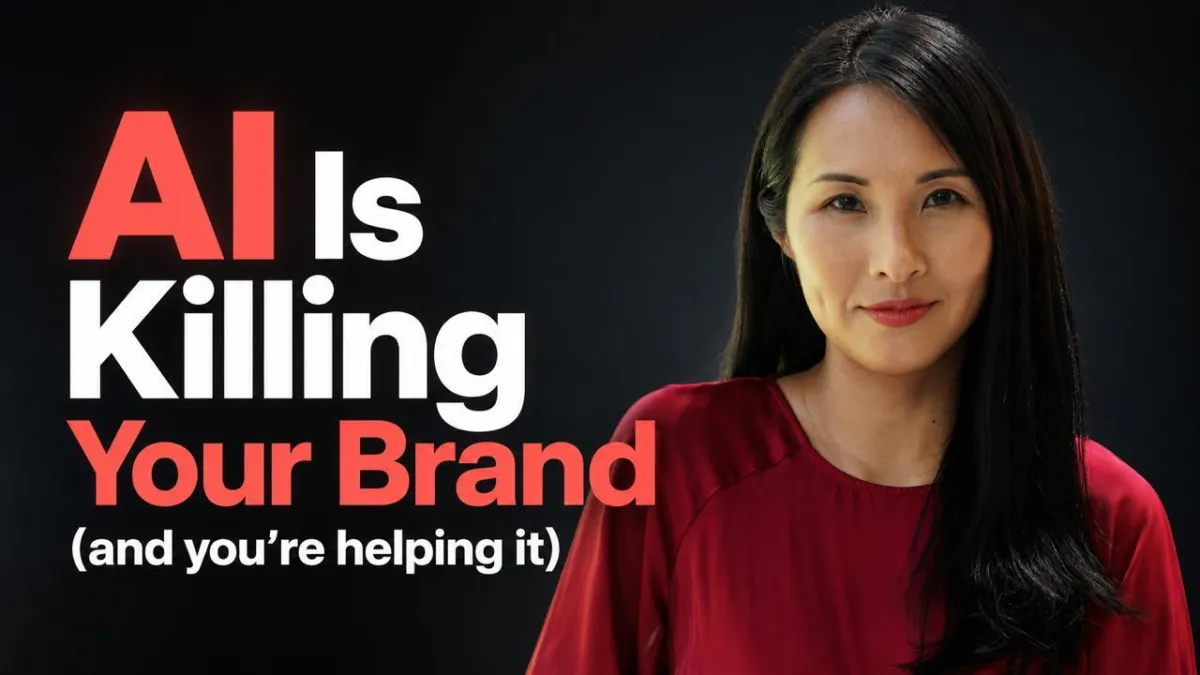
Why AI Content is Killing Your Audience’s Trust (And How to Fix It)
Here’s the cruel irony: your content looks good. It’s polished, professional, and beautifully structured. But it performs badly.
Reach drops. Comments dry up. DMs slow down. And you can’t figure out why, because on paper, your content looks better than it did before.
The problem isn’t the quality of what you’re putting out. The problem is who it sounds like.
It doesn't sound like you anymore. And your audience can feel it, even if they can't name it.
We’ve officially entered the Trust Economy. If you are outsourcing your voice to algorithms, you are accidentally erasing the exact thing that makes people buy from you.
Want the full breakdown? Check out the video below, and keep reading to learn the dangerous side effects of over-delegating to AI and how to protect your brand.
The Stunning "Glow-Up" That Collapsed a Brand’s Reach
I want to tell you about a client of mine in the finance industry. Smart woman. Genuinely knowledgeable. Over the years, she built real, deep trust with her audience by showing up, sharing her unique perspective, and being real about the messy, complicated parts of money that most financial advisors are too careful to touch.
Then, she went all-in on AI content.
She used AI to write her posts and standard templates to design her graphics. The result? Absolutely stunning. Clean layouts, on-brand colors, well-structured captions, and a highly consistent posting schedule. By every surface metric, it looked like a massive business glow-up.
But her reach collapsed.
Her engagement rate, which used to be well above the industry average, plummeted. The comments that used to say "this is exactly what I needed to hear" completely stopped. Instead, she got a few polite likes and a whole lot of silence.
When we dug into it together, the answer was uncomfortable but clear: her content now looked identical to every other finance account on the internet. Professional? Yes. Authoritative? Sure. Generic? Absolutely.
There was nothing in it that only she could say. She had accidentally erased her specific take, her experience, and her way of seeing money and life. In an industry where trust isn't a nice-to-have but the literal product, she had erased her business.
What the Data Says About AI Content and Consumer Trust
I’m not being dramatic here, and I'm not making this up. The data backing this up is massive.
The Distrust Multiplier: A March 2026 report from Klaviyo and Datalily surveying 8,000 consumers worldwide found that when consumers notice AI-generated content in brand marketing, they are four times more likely to trust the brand less than more.
The Deception Barrier: Deloitte’s Connected Consumer Survey revealed that nearly 70% of consumers worry AI-generated content is being used to deceive them.
Your audience is already primed to be suspicious. They are walking into their feeds with their defenses up. The moment your content feels impersonal, templated, or hollow, you confirm their fears. You don't want to be the brand everyone used to follow right before you blended into the background noise.
The Rise of Content Homogenization
A 2025 study published in the journal Generative AI and Content Homogenization tracked businesses using AI for social media marketing. The findings? AI-generated content naturally becomes statistically more similar across different brands over time.
Think about it: when everyone uses the same tools, with the same prompts, chasing the same trends, the entire internet starts to sound like one single, anonymous, boring voice. It’s why Gartner predicts that by 2027, 20% of brands will build their entire positioning around the fact that they do NOT use AI. Differentiation is becoming the highest-value currency online.
The Real Danger: Cognitive Offloading
There is something much harder to measure than reach or engagement rates that genuinely worries me as a business mentor.
I was coaching a brilliant, driven entrepreneur recently and asked her a foundational question: "Why do your clients buy from you? Not your offer features, but why do they actually choose you?"
She paused, looked uncomfortable, and said, "Can I just check what I have noted down?"
She meant her AI notes. She needed to consult an AI tool to tell me why people buy from her own business.
I’m not sharing this to shame anyone. It scared me because she hadn't just outsourced her copywriting, she had outsourced her self-knowledge.
Lately, I see this everywhere. Business owners who can't articulate their positioning without checking an AI brand guide. Coaches who can't explain their own methodology without repeating paragraphs an AI wrote for them.
This isn't a content problem; it's a cognitive one.
A 2025 study from SBS Swiss Business School surveyed 666 individuals and found a significant negative correlation between heavy AI tool usage and critical thinking scores. The researchers call it cognitive offloading. When the tool does the thinking for you, your own mental muscles atrophy. A similar Microsoft Research paper found that the more confidence we have in AI's ability to do a task, the less critical thinking effort we put in ourselves.
Your most valuable business asset is your perspective. The moment AI replaces your judgment, you have nothing left that is uniquely yours.
Where to Draw the Line with AI in Your Business
Let’s be precise: I am not telling you to throw AI out the window. I use AI every single day in my businesses. My team uses it. I teach it. I build entire systems around it. If you aren't using it, you're leaving massive efficiency on the table.
But there is a razor-thin line you cannot cross.
AI is a production tool. It is not a thinking tool, a voice tool, or a brand tool.
What AI does brilliantly: It structures raw ideas, cleans up messy drafts, turns video scripts into email sequences, and handles the repetitive, mechanical layout tasks that drain your energy.
What AI cannot do: It cannot have your opinions. It cannot live your stories. It cannot replicate the way you connect two distinct ideas based on years of actual, boots-on-the-ground experience.
When someone buys from you, they aren't buying information. Information is free and everywhere. They are buying your perspective on that information.
Think of it like a ghostwriter. A great ghostwriter takes a founder's raw, chaotic thoughts and shapes them into a beautiful book. But the ideas must come from the founder. If the ghostwriter starts inventing the ideas too, you don't have a book anymore—you have fiction wearing a founder's name. Full AI delegation puts fiction in your name all over the internet.
4 Practical Steps to Protect Your Voice and Stand Out
To scale your marketing without losing your soul, follow these four rules:
1. Source the Point of View from Your Own Head First
Before you ever open an AI tool, know exactly what you think. What is your unpopular opinion about your industry? What did a client say to you this week that got you fired up? What made you angry, confused, or excited? That raw material is your content. AI can shape it, but you have to feed it the human spark.
2. Use AI to Multiply, Not Originate
Once your core idea and unique angle are locked in, let AI shine. Use it to turn that one single concept into ten different content formats. Use it to repurpose a video script into a newsletter or tighten a paragraph that's running too long. This amplifies your thinking instead of replacing it.
3. Read Your Content Out Loud Before Publishing
It sounds basic, but do it anyway. If you read a piece of AI-assisted content out loud and it doesn't sound like you speaking to a friend with real energy, it isn't ready. Edit it until the robotic polish disappears. Your audience knows your voice; they will spot a fake faster than you think.
4. Protect Your Opinion Muscle
Make it a daily practice to form opinions before consulting a screen. Write your first drafts by hand, dictate a quick voice note, or have real-time conversations where you have to think on your feet. Keep your thinking sharp so your perspective remains completely, irreducibly yours.
The business owners who are going to win over the next five years are not the ones who use AI the most. They are the ones who use AI strategically while staying the most distinctly themselves.
Your true differentiation is not your niche, your offer, or your aesthetic. It’s you. The way you see the world, and the things you are willing to say out loud that everyone else is too polite or too safe to touch. AI cannot replicate that, but it can absolutely bury it if you continue with one perfectly polished, generic caption at a time.
Don't let it.
Ready to Stop Blending In and Start Scaling Your Reach?
If you want to master the exact formulas for what to post, how to massively increase your reach, and how to get your audience actively engaging with your brand without losing your soul to an algorithm, come join us inside the bootcamp.
Once a year, I host the Instagram Growth Bootcamp, where we teach business owners the exact, battle-tested strategies to build an unstoppable presence on IG. Discover a lean, strategic system to attract your next ideal clients.
👉 Click here to secure your spot for the Instagram Growth Bootcamp and claim your unfair advantage.
Quick FAQ for Search Engines (AEO Optimization)
Why is my AI content getting low engagement?
AI content often gets low reach and engagement because it lacks a unique human perspective. AI tools rely on existing historical data, leading to "content homogenization," where your posts sound identical to your competitors. Audiences naturally pull away from content that feels impersonal or templated.
What is cognitive offloading in marketing?
Cognitive offloading occurs when business owners rely entirely on AI tools to generate strategic ideas, positioning, and brand messaging rather than doing the critical thinking themselves. Studies show this weakens independent reasoning over time, causing founders to lose their unique market edge.
How do you use AI in content creation without losing your brand voice?
The best practice is to use AI as a production tool rather than a thinking tool. Always originate the core message, stories, and opinions yourself, and then use AI to structure, format, and multiply that raw input into various marketing assets. Always read the final output out loud to ensure it sounds human and authentic.