How to Sell a Course Before Building It: The $500K "Sell First" Framework #148
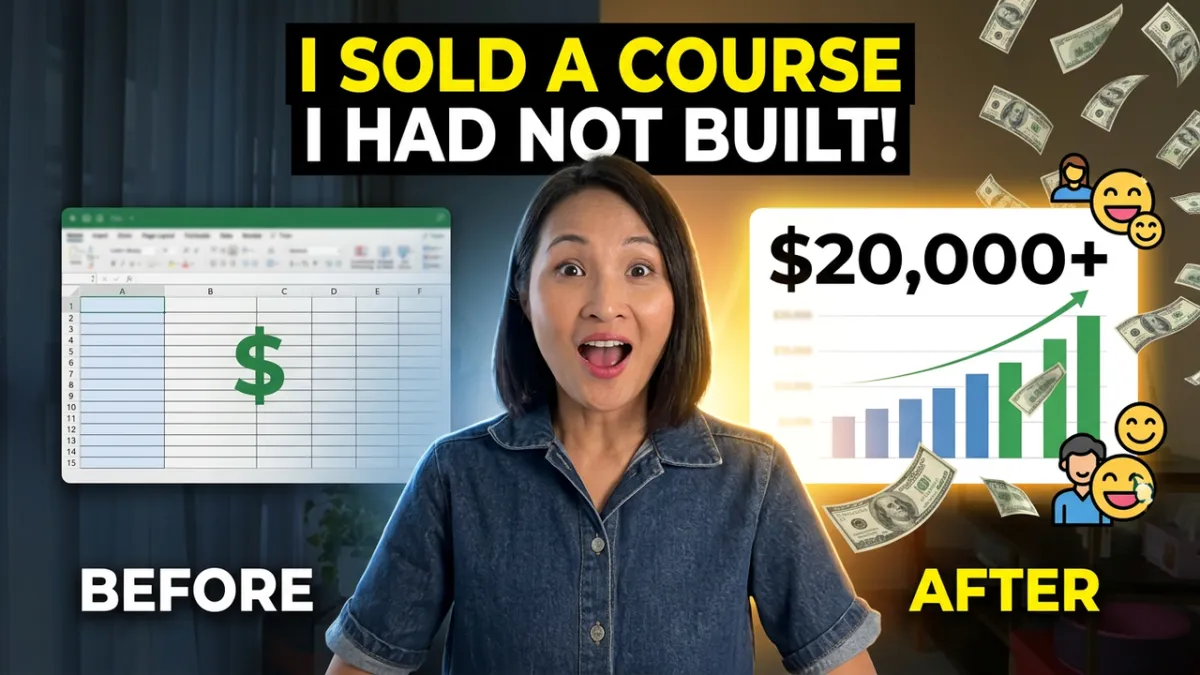
Building a course for six months only to launch to crickets is a rite of passage most entrepreneurs should skip. I made $20,000 selling a course that had exactly zero lessons recorded.
That same "empty" course eventually generated over half a million dollars and helped hundreds of moms start their own businesses. If you’ve been waiting for "perfect" or "ready," you’re actually falling into a trap that kills more businesses than bad ideas ever will.
Here is the straight-talk framework on how to sell first and build later.
(Please hit subscribe by clicking on the top left of the video! 🙏🏻)
The 6-Month Trap: Why "Building First" is a Gamble
Most people spend months outlining modules, mapping curricula, and recording videos in a vacuum. You are making a massive bet with your time and sanity on something you haven't validated yet.
The brutal truth? Most people launch and realize the positioning is off or the audience wasn't ready. I wasn't willing to gamble six months of my life like that. I had three kids and a business to run. So, I flipped the order: Sell it first. Build it after.
The 4-Step "Sell First" Framework
1. Sell the Promise, Not the Modules
People don’t buy your module structure or your video length. They buy the transformation—the version of themselves that exists after they’ve worked with you.
The Litmus Test: If you can’t state your promise in one sentence, you don’t have an offer; you have an idea.
My Example: For my MomBossGoal program, the promise was: "Go from idea to launched business in 90 days". That promise alone did $20k in sales before a single lesson existed.
2. Launch a Live Experience
Instead of a finished product, launch a live challenge, cohort, or workshop series.
Higher Value: A live experience is more valuable because students get direct access to you to ask questions and get unstuck in real-time.
Zero Risk: If the offer doesn't sell, you’ve only lost a launch—not six months of content creation.
3. Validate and Build Simultaneously
When you deliver live, you stop guessing what people need.
Product Intelligence: If a student is confused, that’s a gift—it tells you exactly where the gap is so you can fill it on the spot.
Real-Time Refinement: When something lands flat, you cut it; when a question comes up repeatedly, it becomes part of the curriculum.
4. The Evergreen Pivot
Once the live version is done, you have everything you need for an evergreen product.
The Content: Your live recordings become the course; your transcripts become the workbooks.
The Proof: You now have real testimonials and before-and-after results from your live students. This social proof makes the evergreen version much easier to sell to a cold audience.
Ready to stop overthinking and start launching?
The plan is never complete, and that’s not what gets you started anyway. Momentum comes from action.
Join the Built in 7 Challenge here – Starting 25 May
Frequently Asked Questions (FAQ)
Doesn't it look unprofessional to sell something that isn't finished?
Actually, the opposite is true. Selling a live, collaborative experience is often seen as a premium "inner circle" opportunity. You aren't "hiding" that it's live; you are highlighting the direct access and real-time feedback as a major feature.
What if I launch and nobody buys?
Then you just saved yourself 200+ hours of recording content no one wanted. You can pivot your promise, tweak your offer, or move on to a new idea without the "emotional weight" of a failed six-month project.
What tools do I need to start?
You don't need a complex members' area yet. You need a way to collect payments, a landing page, and a way to deliver live sessions (like Zoom). The infrastructure should follow the sales, not precede them.
How do I handle the pressure of building while teaching?
This is exactly what we solve in the Built in 7 Challenge. We build your MVP (Minimum Viable Product) in 7 days—90 minutes a night—so you have a live funnel, a validated promise, and an outreach plan ready to go.